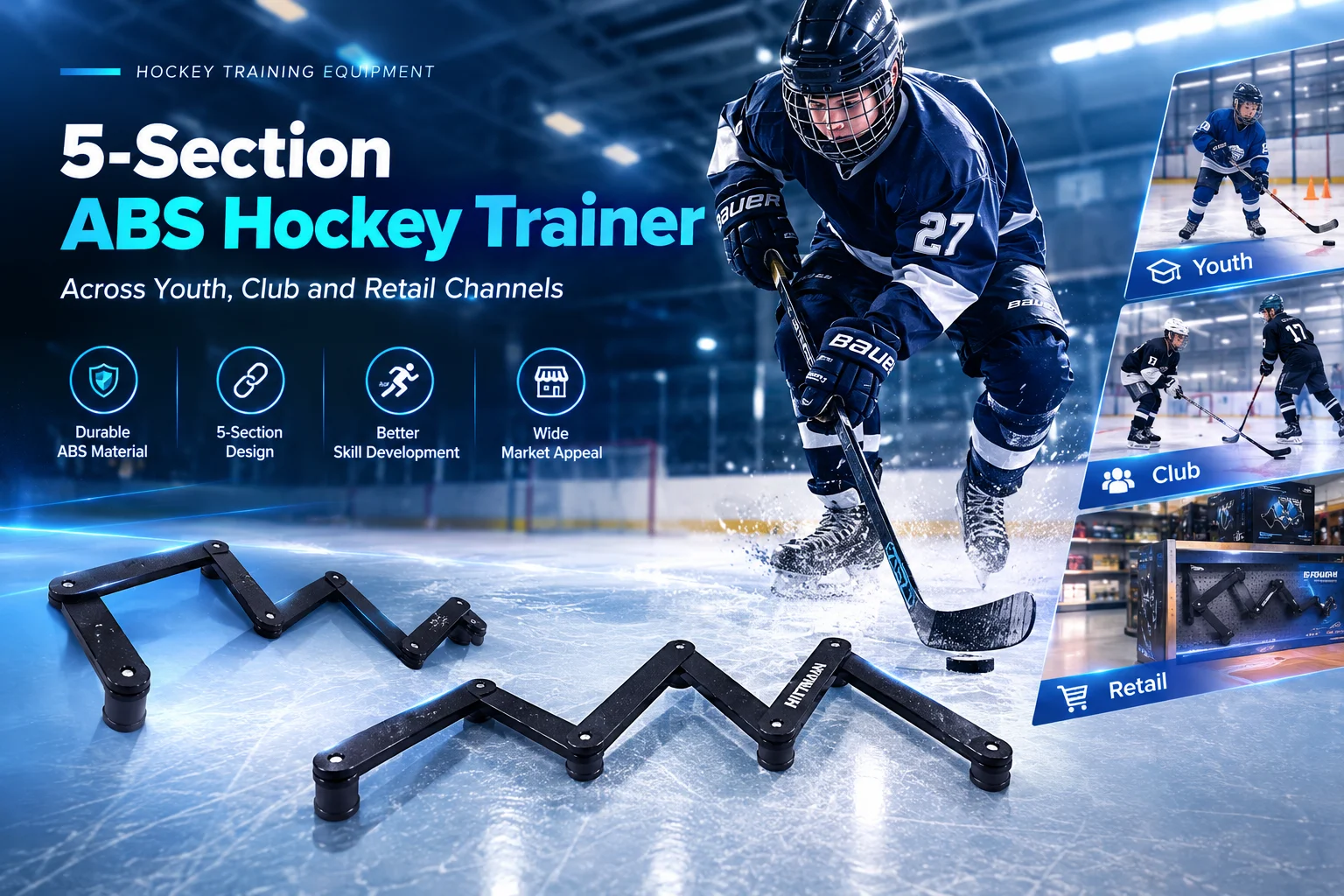
A 5-section ABS hockey shooting trainer is far more versatile than most distributors realize. The same molded product can be sold to youth hockey schools, academy teams, retail e-commerce customers, and even professional training staff — but each channel needs a different sales narrative, packaging format, and price positioning. This guide helps B2B distributors and brands map one product to multiple channels without diluting the brand.
Channel 1: Youth Hockey Schools — Skill-Building for Beginners
Youth programs buy trainers to teach basic puck control, shooting form, and repetition. The 5-section adjustable design is a selling point here because coaches can reduce the layout difficulty for younger age groups. Key messaging:
- Adjustable 5-section setup scales from U8 to U14 skill levels.
- Durable ABS construction survives daily outdoor rink and garage use.
- Portable enough to carry to practice and store between sessions.
Price positioning: mid-range, sold as a “training system” in bulk to schools and community programs. Packaging should emphasize coaching value, age-grade adjustability, and safety of ABS edges.
Channel 2: Clubs and Academies — Advanced Reaction Training
Club and academy programs use the same trainer for more complex drills: reaction shooting, simulated game scenarios, and repeatable layout variation. The sales pitch shifts from “adjustable for beginners” to “configurable for drill variety.”
- Multiple layout configurations to simulate defensive angles and passing lanes.
- Quick setup/teardown between drill stations in a single session.
- Bulk purchase options for multi-team academies.
Industry procurement data shows training-system products range from $263 to $23,800 depending on configuration and bundle. Academies sit in the mid-to-upper band because they buy multi-station kits with carrying bags and coaching manuals.
Channel 3: Retail / E-Commerce — The “Gift” Purchase
Online retail customers are usually parents buying for a child, or adult players buying for themselves. The same 5-section trainer is marketed as a portable, out-of-the-box gift:
- Compact packaging that ships to a home address without freight surcharges.
- Clear, illustrated setup instructions for non-coaches.
- “Bring it to the garage, basement, or driveway” lifestyle imagery.
Retail packaging must be self-explanatory: the customer has never seen the product in person. Box art should show a player using it, list the 5 sections, and highlight that no tools are required.
Why Channel Differentiation Matters
The mistake many distributors make is using one listing and one sales deck for all channels. A school coach cares about age-grade adjustability; a parent on Amazon cares about gift-ready packaging; a club equipment manager cares about bulk pricing and durability. The product itself does not need to change — the messaging, packaging insert, and SKU variant do.
Practical approach:
- Create three SKU variants of the same trainer: Youth Bundle, Academy Pro Bundle, and Retail Box.
- Use different inserts: coaching drill card for schools, multi-station manual for academies, and quick-start guide for retail.
- Price each variant to the channel’s willingness to pay, not to a single RRP.
FAQ
Q: What is the difference between youth training and pro team training needs?
A: Youth programs prioritize adjustable difficulty and durability for beginners. Pro and academy teams prioritize drill variety, multi-station configuration, and quick layout changes. The 5-section design supports both, but the sales narrative changes.
Q: How do packaging and instructions differ between e-commerce and club procurement?
A: Retail boxes need lifestyle imagery, tool-free setup visuals, and a self-contained quick-start guide. Club purchases need bulk carton packing, a coaching manual, and a parts replacement sheet. Same product, different insert and outer box.
Q: How do you use portability to appeal to parents?
A: Emphasize that the trainer assembles in minutes, fits in a car trunk, and works in a garage or driveway — no ice time required. Parents buy peace of mind: their child can practice at home without a facility.
At Tiger Brother Plastic, we custom injection-mold ABS training equipment and develop channel-specific packaging and tooling for sports brands and distributors. Contact us for OEM/ODM product development and bulk manufacturing.