

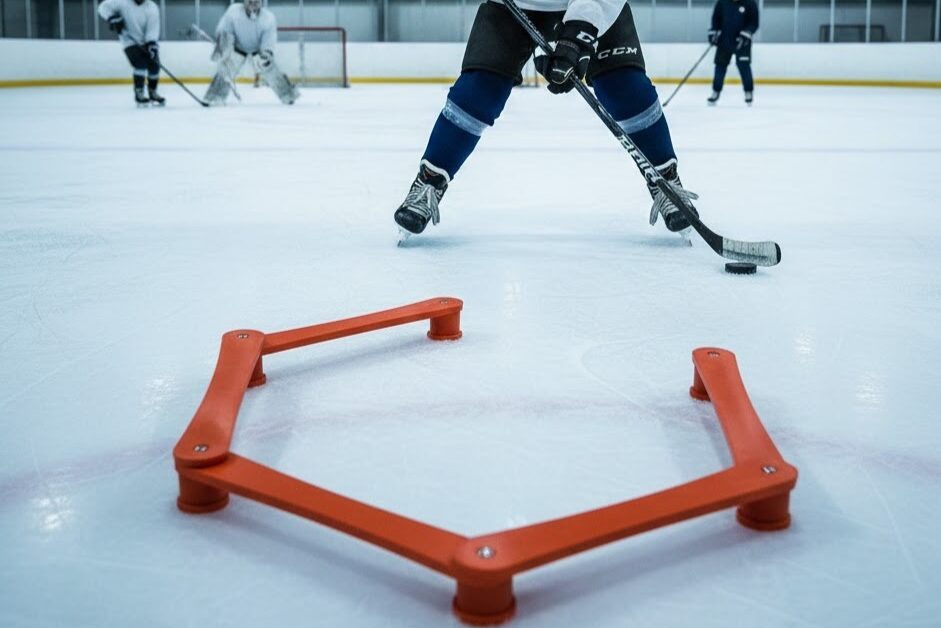
In the world of professional ice hockey, there is a sacred connection between the player’s nerves and the puck. This “feel,” or “puck handling intuition,” is a perishable skill. It is forged through thousands of hours of repetition, but it can evaporate during the time spent away from the rink. Traditionally, the barrier to mastery has been the ice itself—ice time is expensive, geographically limited, and constrained by rigid schedules.
However, a revolution in ABS injection-molded sports equipment is fundamentally changing the training landscape. By compressing the core dynamics of the rink into a portable, high-durability training system, players can now maintain a “dialogue” with the sport anywhere—from a garage floor to a gym corner or an outdoor driveway. This article explores how advanced injection molding technology has created a “mobile mini-rink,” ensuring that a player’s hand-speed and tactile reaction never cool down, even when the ice is miles away.
1. The Challenge of “Perishable Mastery”: Why Off-Ice Training is Essential
Hockey is a sport of high-speed micro-adjustments. The difference between a successful deke and a turnover is measured in millimeters and milliseconds.
The Scarcity of the Ice
For most players, actual ice time is restricted to just a few hours a week. In the gaps between these sessions, “muscle memory” begins to soften. Without a way to simulate the friction and response of the puck, the hands become sluggish.
-
The Accessibility Gap: Traditional off-ice training was often limited to heavy, static equipment that didn’t travel well or mimic the “slickness” of the ice.
-
The Solution of Portability: Modern players demand gear that fits their lifestyle. They need equipment that is light enough to carry in a gear bag but tough enough to survive the high-impact nature of the sport.
2. The ABS Advantage: Material Science Behind the Training “Feel.”
When designing ABS injection-molded sports equipment, the choice of Acrylonitrile Butadiene Styrene (ABS) is a strategic engineering decision. It is the perfect medium for replicating the physical properties of a winter environment in a summer setting.
Replicating the Low-Friction Surface
The primary goal of a hockey trainer is to mimic the “glide.”
-
Surface Tension: Through precision injection molding, the surface of the ABS can be finished to a specific low-coefficient of friction. When paired with a training puck or ball, it replicates the “slide” of the ice, allowing for authentic stickhandling drills.
-
Impact Resistance: ABS is renowned for its toughness. In hockey, equipment is constantly struck by sticks and pucks. The “Butadiene” component in ABS provides the impact strength necessary to prevent cracking or shattering, even under aggressive use.
Thermal Stability and Consistency
Unlike cheaper plastics that become brittle in the cold or soft in the heat, high-grade ABS, produced through professional injection molding, offers remarkable dimensional stability. Whether training in a humid summer garage or a chilly basement, the equipment responds with the same “bounce” and “click,” providing the consistent feedback required to build elite muscle memory.
3. The “Mobile Mini-Rink”: Designing for Portability and Versatility
The true magic of modern training gear lies in its “compressed” design. It is about distilling the core functions of a $50-million arena into a 2-kilogram piece of portable hardware.
Modular and Collapsible Geometry
Advanced injection molding enables complex, interlocking geometries that are not possible with wood or metal.
-
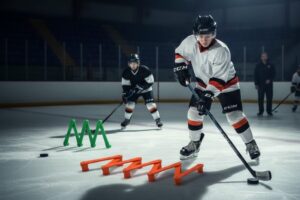
Snap-Fit Systems: Trainers can be designed as modular “tiles” or collapsible “passers” that snap together in seconds. This allows a player to build a customized training circuit on any flat surface.
-
Lightweight Structural Integrity: By utilizing “ribbing” and hollow-core designs within the injection molded parts, engineers can reduce weight by 40% without sacrificing the rigidity needed to withstand a 100mph slapshot.
The “Unseen” Coach: Tactile Feedback
A well-designed ABS trainer acts as a “silent coach.” The resonance of the plastic—the specific “thud” or “ping” it makes when struck—provides auditory and tactile cues to the player. It tells them if their pass was flat, if their stick-blade was closed, or if their reaction time was lagging. This “Sensory Dialogue” is what keeps the hand-eye coordination sharp during the off-season.
4. From Garage to Greatness: The Psychological Edge of “Always-On” Training
Training accessibility isn’t just a physical advantage; it is a psychological one. When a player knows they can “get their reps in” at any moment, their confidence grows.
-
The “Anywhere” Ritual: By eliminating the need to drive to a rink, training friction disappears. As a result, players can start a 15-minute drill session instantly. This encourages the “fragmented training” model, where small, daily sessions lead to massive technical gains over time.
-
Democratizing Elite Skills: High-quality ABS injection-molded sports equipments make elite-level training tools affordable for the average family. It levels the playing field, allowing players from non-traditional hockey markets to develop the same “silky hands” as those with backyard rinks.
5. Longevity and Value
Investing in professional-grade injection-molded gear is a decision in long-term performance equity.
-
Indestructible Value: Unlike foam or low-density polyethylene (LDPE) alternatives, high-pressure ABS molding creates a product with a service life measured in years, not months.
-
Weather Resilience: ABS is naturally resistant to many chemicals and UV rays. It won’t warp under the sun or rot in a damp shed, making it a “buy-it-once” solution for serious athletes.
-
Precision Engineering: Injection molding ensures that every unit is a perfect clone of the master design. There are no “weak spots” or manufacturing variances, ensuring that the training experience is identical for every player.
6. Conclusion: The Hands Never Sleep
The “soul” of hockey is not found in the ice, but in the hands of the player. By utilizing the precision and durability of ABS injection-molded sports equipment, we have successfully decoupled the skill of hockey from the geography of the rink.
The “Mobile Mini-Rink” is more than a convenience; it is a technical necessity for the modern competitor. It ensures that the “feel” for the game remains warm, sharp, and ready, regardless of the season or the setting. In the quiet of a garage or the sun of a driveway, the dialogue between the player and the puck continues, proving that with the right equipment, your (hand-feel) truly never has to cool down.




Add comment