

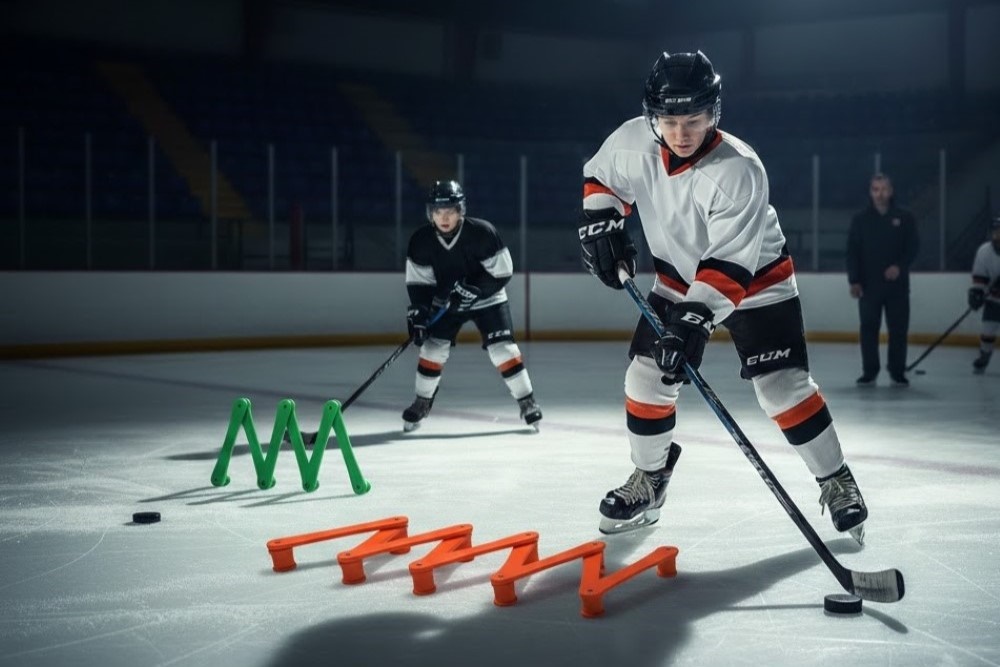
In the world of high-performance sports, few environments are as physically punishing as the hockey rink. It is a world defined by “brute force” physics—the relentless crack of a 100-mph slap-shot, the bone-chilling cold of sub-zero temperatures, and the violent friction of blades on ice. In this arena, a hockey training aid is not just a tool; it is a shock absorber for an athlete’s ambition.
The true value of an injection-molded hockey training gear lies not in how it performs on Day 1, but in how it survives Day 1,000. When a piece of equipment undergoes tens of thousands of high-velocity impacts, the “Curse of Fatigue” usually begins to set in—cracks appear, shapes deform, and the reliable feedback the athlete depends on begins to blur. However, through the lens of advanced material science and “Long-Termist” engineering, we are redefining what it means to be durable. This article explores how top-tier injection molding becomes a “Time Capsule” of performance, ensuring that whether it is the first or the ten-thousandth strike, the equipment remains a faithful partner to the player’s journey.
1. The Physics of the “Strike”: Understanding the Brutality of Hockey Training
To build a product that lasts, one must first respect the enemy: kinetic energy and thermal stress.
The Puck as a Projectile
A standard vulcanized rubber puck is a 6-ounce projectile traveling at speeds that can exceed 160km. Upon impact, the training gear must absorb a massive amount of energy in a fraction of a second. If the injection-molded part is too rigid, it shatters like glass. If it is too soft, it deforms, losing the “true bounce” required for skill development.
The -30°C Challenge
Plastics are notoriously sensitive to temperature. In the extreme cold of an ice rink, most standard polymers become brittle. The molecular chains “freeze,” and the once-flexible plastic loses its ability to dissipate energy. A training aid that works in a showroom but fails in a -30℃ outdoor rink is a failure of engineering. Top-tier gear must maintain “Cold-Impact Strength”—a specialized metric that ensures the material remains ductile and resilient even when the mercury drops.
2. The Science of “Fatigue Resistance”: The Secret to Longevity
In material science, “Fatigue” refers to the progressive structural damage that occurs when a material is subjected to cyclic loading.
The Molecular “Spring”
Every time a puck hits an injection-molded rebounding board or shooting target, the plastic molecules are stretched. In low-quality products, these molecules do not return to their original position perfectly; they leave behind microscopic tears. Over thousands of strikes, these tears coalesce into visible cracks.
-
High-Molecular-Weight Polymers: Elite training gear utilizes specialized resins, such as Impact-Modified Polypropylene or high-density Polyethylene blends. These materials act like a “Molecular Spring.” They are engineered with long, intertwined polymer chains that can slide and stretch without breaking, allowing the part to return to its 100% original shape every single time.
The “Stress-Free” Mold
Durability isn’t just about the material; it’s about the process. During the injection molding cycle, if the plastic is cooled too quickly or unevenly, “internal stress” is locked into the part.
-
Precision Cooling: Advanced injection molding uses sophisticated thermal management within the mold. By ensuring the part cools uniformly, we eliminate the “invisible fault lines” that cause premature failure. The result is a part that is structurally consistent from the core to the surface.
3. Consistency as a Coach: Why Precision Matters Over Time
For a hockey player, the injection-molded hockey training gear is a “Silent Coach.” It provides the feedback necessary to build muscle memory. If the gear changes its response over time, the athlete’s training becomes counterproductive.
-
Dimensional Stability: If a passing rebounder warps by even 2 degrees after a season of use, the angle of the return pass changes. The athlete begins to compensate for the equipment’s flaws rather than improving their own technique.
-
The “Time Capsule” Effect: A top-tier injection-molded product is designed to be a constant. It ensures that the “bounce” you feel during the summer off-season is the same “bounce” you feel during the mid-winter playoffs. By preserving the original design intent through the years, the gear ensures that the athlete’s sweat and passion are never wasted on decaying equipment.
4. Beyond the Strike: Resistance to the “Silent Eroder.”
Impact is only one half of the battle. Training gear often lives a rough life—tossed into equipment bags, dragged across asphalt, and exposed to the sun.
-
UV Stabilization: For training aids used on outdoor rinks or driveways, UV radiation from the sun is a silent killer. It breaks the chemical bonds of the plastic, causing “chalking” and brittleness. High-end injection molding includes UV-inhibitor additives that act as a “sunscreen” for the equipment, preserving its vibrant color and structural integrity for years.
-
Chemical Resilience: From the salt used on icy roads to the cleaning agents used in rinks, the equipment faces chemical stress. Specialized resin selection ensures that the surface remains non-porous and resistant to chemical degradation, preventing the material from becoming “spongy” or weak.
 5. The ROI of “Long-Termism”: Efficiency for Organizations and Individuals
 5. The ROI of “Long-Termism”: Efficiency for Organizations and Individuals
Why invest in “Top-Tier” when “Good Enough” is available? The answer lies in the Total Cost of Ownership (TCO).
-
The Replacement Cycle: A cheap injection-molded hockey training gear that needs to be replaced every season is, in the long run, far more expensive than a premium product that lasts five years.
-
Reliability for Pro Teams: For professional organizations and training academies, equipment downtime is a logistical nightmare. Using gear that is “Faithful to its Design” ensures that training schedules remain on track and athletes remain safe.
-
Safety First: A cracked or splintered piece of plastic is a safety hazard. High-impact injection molding ensures that even if the part eventually reaches its limit, it fails “gracefully” (denting rather than shattering), protecting the player from sharp debris.
6. Conclusion: The Legacy of the Mold
The goal of elite injection molding is to create something that feels “Eternal.” In the violent, high-friction world of hockey, “Durability” is the ultimate luxury. It is the silent promise that the equipment will never give up before the athlete does.
When a training aid can withstand tens of thousands of puck strikes, survive the bitter cold, and still look and perform as it did on the day it left the factory, it has achieved the pinnacle of engineering. It has become a bridge between the athlete’s effort and their eventual success. By choosing a product that stays true to its original design, you aren’t just buying plastic; you are buying a “Time Capsule” of performance—a guardian that ensures every drop of sweat contributes to a better game.




Add comment