

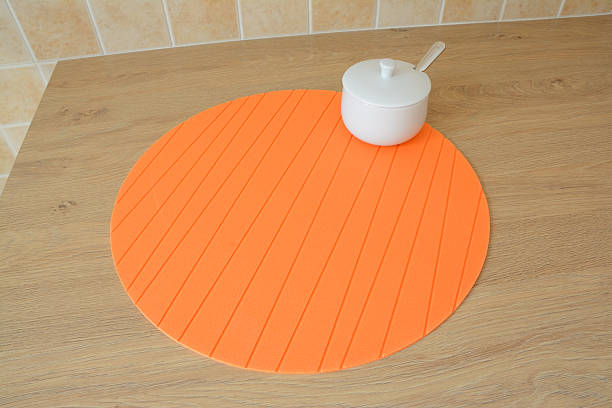
Homeware product developers, commercial restaurant buyers, and kitchenware brand managers must balance sleek aesthetic styling against strict thermal protection capabilities. When selecting table protection liners, procurement teams frequently encounter a practical, vital question: “Silicone heat insulation mats come in various gauges like 2mm, 4mm, and 6mm. Does a thicker mat always guarantee better heat retention, and will a 4mm pad fully protect delicate wood and marble surfaces from scorching?”
While increasing the thickness of an elastomer barrier naturally delays heat transfer, the raw thickness metric tells only half of the thermodynamic story. Sourcing a high-purity silicone heat insulation mat fleet ensures that your tables withstand intense everyday culinary heat without warping or scorching. This engineering guide details the mathematical relationship between polymer thickness and thermal insulation to help you select the ideal thickness for your product line.
1. The Thermodynamic Formula: Thickness vs. Thermal Resistance
To evaluate whether a 4mm pad can fully block high temperatures, your quality control team must analyze how heat flows through a dense polymer matrix.
 Thin 2mm Mat Layer:  [Boiling 100°C Cast Iron] ──> Fast Heat Breakthrough ──> ❌ Tabletop Surface Scorch
 Optimal 4mm Mat Layer: [Boiling 100°C Cast Iron] ──> Heat Dissipated Safely  ──> ♻️ Perfect Table Protection
In the study of thermodynamics, the ability of a solid material to resist heat flow depends directly on its thickness and its native material’s thermal conductivity. When you double the physical thickness of a uniform silicone sheet, you double its overall thermal resistance, which slows down the speed at which heat moves from a hot pan to the table below.
For standard household applications, a silicone heat insulation mat with a thickness of 4mm provides an exceptionally safe and highly effective thermal shield. This specific dimension creates an adequate physical gap that safely handles temperatures up to 230℃ (446℉). This protection level ensures that boiling water pots, heavy ceramic soup tureens, and freshly baked cookie sheets will not discolor or damage your fine wood veneered or polished marble tables.
2. Material Density and Internal Air Structures Matter More Than Thickness
A common, costly sourcing mistake involves assuming that a thick mat always delivers superior insulation compared to a slightly thinner version.
Internal Structural Profile Comparison:
Dense Solid Silicone Mat: Excellent load support; steady heat drift.
Foamed Sponge Silicone Mat: Microscopic air pockets trap heat loops.
The overall thermal performance of any silicone component depends heavily on its internal compounding density and cell structure rather than raw thickness alone:
-
Solid Silicone Formulations: High-density, solid-injected silicone offers superb structural stability and withstands heavy indentation pressure without flattening. However, because the molecules are packed tightly together, heat travels through the material at a steady, predictable rate.
-
Foamed/Sponge Silicone Formulations: Specialized foamed silicone incorporates millions of microscopic, trapped air pockets inside its structure. Because air exhibits a much lower thermal conductivity than solid rubber, these tiny pockets block heat flow exceptionally well, allowing a 4mm foamed mat to easily outperform a standard 6mm solid sheet.
Therefore, corporate sourcing teams must choose the right material structure for their specific application. If your project prioritizes maximum thermal blocking above all else, you should select a foamed structure. However, if your application demands high load-bearing capacity to support heavy dishes without compressing, a high-purity solid injection setup provides the best overall balance.
3. Strategic Application Matching: Choosing Your Ideal Thickness Guideline
To optimize your product line for retail or commercial use, you should select your silicone thickness based on clear, real-world cooking scenarios.
 Standard Dinnerware / Coffee Cups  ──> Deploy Sleek 2mm to 3mm Mats
 Heavy Boiling Pots / Domestic Cook ──> Deploy Balanced 4mm Mats
 Heavy Cast Iron / Professional Chef ──> Deploy Heavy-Duty 6mm+ Mats
-
Standard Household Dining (4mm Standard): A 4mm solid gauge serves as the ideal benchmark for everyday domestic use. It offers a sleek, modern look on dining tables while providing reliable protection against hot serving bowls, tea kettles, and dinner plates.
-
Heavy Cast-Iron Cookware (6mm+ Heavy-Duty): If your target market uses heavy cast-iron skillets or Dutch ovens frequently, you should upgrade your specification to 6mm or thicker. Heavy cast-iron cookware retains immense amounts of thermal energy and presses down hard on the rubber, which can compress thin mats and transfer heat directly to the table surface.
-
Professional Kitchen Environments: For high-volume restaurant lines, always demand explicit raw material datasheets from your factory. Ensure the silicone compound maintains its structural form under constant high-temperature contact without emitting odors or sticking to tables.
Silicone Insulation Mat Structural Comparison
| Critical Engineering Metric | Thin Economy Mats (2mm) | Balanced Standard Mats (4mm) | Heavy-Duty Premium Mats (≥6mm) |
| Table Scorch Protection | Poor; high risk with hot cookware | Excellent for all daily household uses | Absolute safety for hot cast-iron pans |
| Heat Dissipation Rate | Rapid heat breakthrough to the table | Slow heat transfer; keeps tables safe | Ultra-slow heat transfer over long periods |
| Weight-Bearing Resistance | Low; heavy pots compress it flat | High; retains shape under heavy dishes | Maximum: handles heavy kitchen equipment |
| Material Volume and Cost | Low production cost; shorter life | Optimal price-to-performance ratio | Higher material volume adds to unit cost |
| Primary Use Matching | Coffee mugs, teapots, and small bowls | Hot dinner plates, skillets, and baking pans | Heavy commercial kitchens and hot stone pots |
Conclusion: Future-Proof Your Homeware Product Sourcing
In conclusion, scaling a successful consumer kitchenware brand requires sourcing rugged, high-performance components that safeguard expensive furniture investments.
Stop risking your development capital and retail brand reputation on thin, low-grade plastic trivets that melt under high heat, crack over time, and cause costly table damage. Upgrading your bulk product inventory to our precision-molded silicone heat insulation mat lines guarantees excellent thermal protection, long-term durability, and complete chemical safety. We engineer every custom injection run using high-purity, food-grade polymers to ensure your products look great and perform flawlessly in high-temperature environments. Contact our corporate manufacturing division today to submit your product design specs and lock in your next wholesale production run.






Add comment