

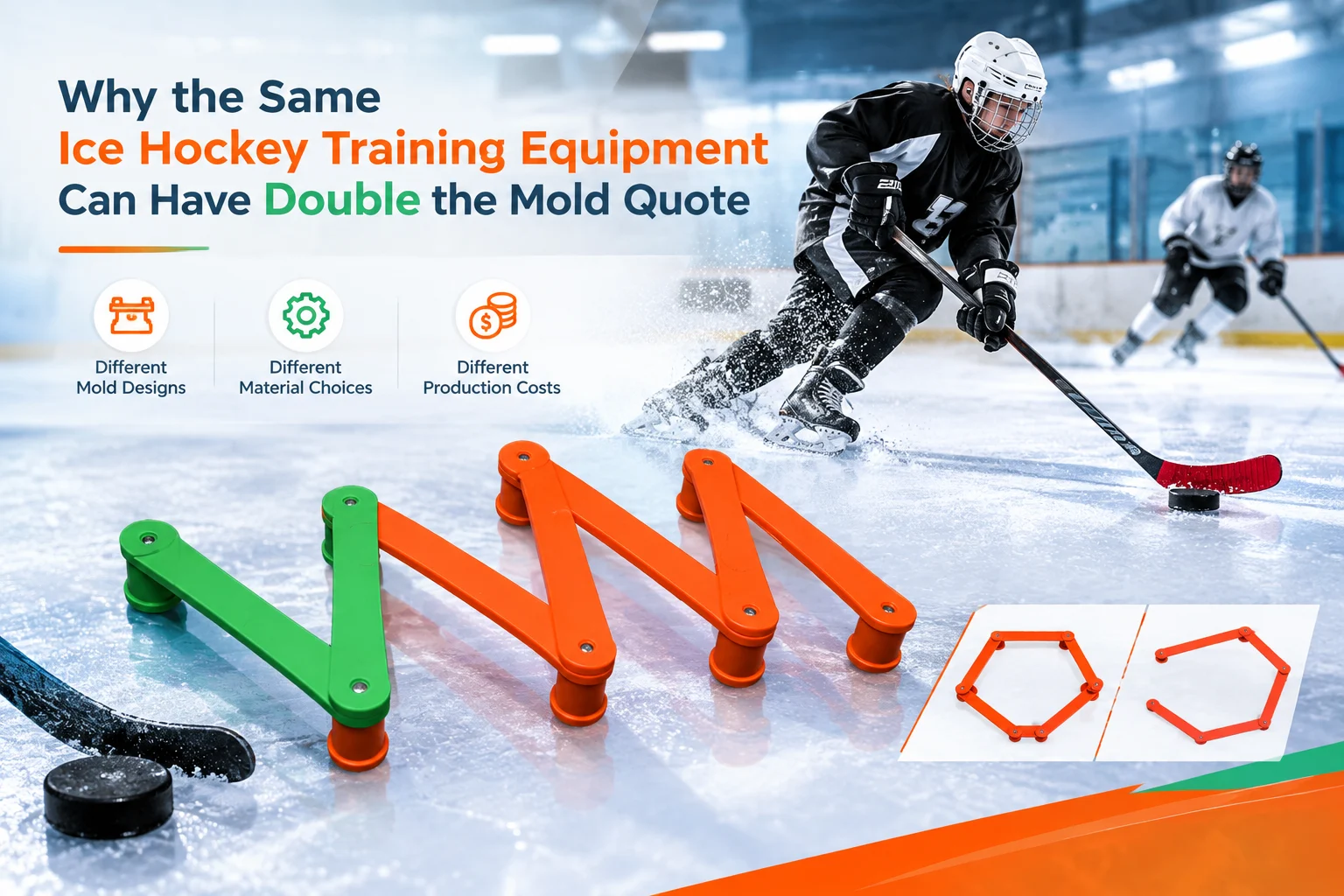
When buyers request a quote for custom injection-molded ice hockey training equipment, the product price is often not the biggest surprise. The injection mold quote can vary dramatically between suppliers.
Two factories may receive the same CAD file and provide mold quotes that differ by 50%, 100%, or even more.
This does not automatically mean one supplier is overcharging.
The difference may come from mold steel, cavity count, cooling design, machining requirements, mold life, tolerances, surface finish, and the amount of engineering work included in the quotation.
For a medium-complexity product such as an injection-molded ice hockey training aid, understanding these factors is more useful than simply choosing the lowest mold price.
In many cases, P20 pre-hardened steel molds can offer a practical balance between upfront tooling cost, durability, machining performance, and production volume.
The real question is not:
“Which mold is cheapest?”
It is:
“Which mold construction provides the lowest total cost for the expected production volume and product requirements?”
What Is Included in an Injection Mold Cost?
An injection mold is more than a block of steel with a cavity.
A typical mold quotation may include:
- Product and mold design
- Mold-flow analysis
- Mold base
- Core and cavity inserts
- Mold steel
- CNC machining
- EDM machining
- Wire cutting
- Drilling
- Cooling channels
- Ejector system
- Runner system
- Gates
- Sliders or lifters
- Surface finishing
- Assembly
- Mold testing
- Trial shots
- Mold modifications
- Final inspection
Different suppliers may include different items in their initial quote.
This is one reason two apparently similar mold quotations can be difficult to compare.
A quote of $10,000 and another of $20,000 may not represent the same tooling specification.
The first supplier may quote a basic mold with limited trials.
The second may include a more durable steel grade, optimized cooling, higher machining precision, multiple mold trials, and a longer expected service life.
Therefore, buyers should compare mold specifications, not only mold prices.
Why Can Two Injection Mold Quotes Differ So Much?
Several variables have a direct impact on injection mold cost.
The most important are:
- Mold material
- Product geometry
- Number of cavities
- Mold structure
- Machining process
- Tolerance requirements
- Cooling system
- Expected mold life
- Production volume
- Surface and appearance requirements
These factors interact with each other.
A simple product with premium steel may still be inexpensive to manufacture.
A complex product using cheaper steel may require extensive EDM, sliders, lifters, and manual finishing.
Therefore, material price alone does not determine tooling cost.
1. Mold Material Has a Major Impact on Price
Mold steel is one of the most visible differences between tooling quotations.
Common options include:
- Aluminum
- P20 pre-hardened steel
- 718 steel
- H13 steel
- S136 stainless mold steel
- Other hardened tool steels
The appropriate material depends on production volume, product geometry, surface requirements, resin type, and expected mold life.
Aluminum Molds
Aluminum is attractive for prototypes and low-volume production because it is relatively easy to machine.
It can provide:
- Faster machining
- Lower initial tooling cost
- Shorter development cycles
- Good heat transfer
- Suitable performance for certain low-volume applications
However, aluminum generally has lower wear resistance than steel.
For a buyer expecting continuous production, a very low aluminum tooling quote may not represent the best economic choice.
A mold that saves several thousand dollars initially but requires early replacement can become expensive over the product’s lifetime.
P20 Pre-Hardened Steel
P20 is widely used for general-purpose injection mold tooling.
Its main advantage is balance.
It can provide a combination of:
- Good machinability
- Adequate hardness
- Reasonable wear resistance
- Good polishability for many applications
- Suitable production durability
- Relatively predictable machining costs
For a medium-complexity injection molded ice hockey training equipment project with recurring production demand, P20 can often be a practical tooling option.
A typical project-specific P20 mold quote might fall in the several-thousand to tens-of-thousands-of-dollars range, depending heavily on size, cavity count, mold structure, machining, and required mold life.
The frequently discussed $5,000–$25,000 range should therefore be treated as a planning reference rather than a universal market price.
2. Why the Cheapest Aluminum Mold May Not Be the Best Choice
Suppose a buyer receives these two quotations:
| Option | Initial Mold Cost | Expected Application |
|---|---|---|
| Aluminum mold | $6,000 | Prototype / low volume |
| P20 steel mold | $15,000 | Repeated production |
At first glance, the aluminum mold looks much cheaper.
But imagine the product requires 100,000 or 200,000 units over its commercial life.
The relevant calculation becomes:
Initial tooling cost + maintenance + downtime + replacement tooling + production risk
rather than simply:
Initial tooling cost
For a product with recurring orders, a more durable steel mold can produce a lower tooling cost per unit over the complete production cycle.
This is why buyers should calculate tooling economics over the expected product lifetime.
3. Product Complexity Can Matter More Than Steel Price
A simple hockey training puck tray may require relatively straightforward tooling.
A more complex hockey training device may contain:
- Curved surfaces
- Deep ribs
- Internal cavities
- Snap-fit features
- Undercuts
- Multiple functional surfaces
- Reinforcing structures
- Moving components
- Textured surfaces
Each feature can increase tooling complexity.
For example, an undercut may require a:
Slider → angled lifter → collapsible core → or another specialized mold mechanism
The exact solution depends on the geometry.
The mechanism itself is not necessarily expensive.
The machining, assembly, adjustment, and maintenance requirements are what increase the total tooling cost.
4. Sliders and Lifters Can Quickly Increase Tooling Cost
A mold with a straightforward opening direction is relatively simple.
The situation changes when the product contains side undercuts.
A traditional two-plate mold may no longer be sufficient.
The tool may require sliders.
Example
Imagine an ice hockey training device with a side locking feature.
If the feature cannot be removed directly along the mold opening direction, the mold may require a side-action mechanism.
That introduces additional components:
- Slider body
- Wear plates
- Angle pin
- Guide components
- Locking system
- Additional cooling considerations
More components mean more machining and assembly.
Therefore, when comparing two quotations, buyers should ask:
Does one supplier’s design require more moving mold components?
5. Mold Design Can Change the Quote Before Machining Starts
A major portion of tooling cost is created before steel is cut.
The mold designer needs to determine:
- Parting line
- Mold opening direction
- Gate location
- Runner design
- Ejection strategy
- Cooling layout
- Draft angles
- Wall thickness
- Shrinkage compensation
- Slider requirements
- Lifter requirements
A poorly optimized product design may force the mold maker to build a more complicated tool.
Sometimes, a small change to the plastic part can significantly simplify the mold.
For example:
Original design → side undercut → slider required
versus:
Modified geometry → self-releasing feature → simpler two-plate mold
The second solution may reduce tooling cost without reducing product functionality.
This is why DFM analysis should be performed before the final mold quotation is accepted.
6. Cavity Count Changes the Economics
Another important variable is the number of cavities.
A single-cavity mold produces one part per molding cycle.
A four-cavity mold produces four parts.
An eight-cavity mold produces eight.
This can significantly improve production efficiency.
However, more cavities also increase tooling cost.
A multi-cavity mold requires:
- Larger mold dimensions
- More cavity machining
- More cooling circuits
- More complex runner balancing
- More ejection components
- More precise mold alignment
Therefore, increasing cavity count is not automatically better.
How Should Buyers Choose?
For low-volume products:
1 cavity → lower tooling investment
For moderate-volume products:
2–4 cavities → potentially better production economics
For high-volume products:
4–8+ cavities → potentially lower per-unit production cost
The optimal number depends on annual demand, machine capacity, cycle time, product size, and target unit cost.
7. Cooling Design Can Explain a Higher Quote
Cooling is sometimes overlooked because it is invisible after the mold is assembled.
However, cooling design directly influences cycle time and dimensional stability.
A poorly cooled mold may require:
- Longer cooling time
- Higher cycle time
- Greater dimensional variation
- Higher production cost
A well-designed cooling system can use:
- Optimized cooling-channel locations
- Separate cooling circuits
- Baffles
- Bubblers
- Conformal cooling in advanced applications
For a relatively large injection molded hockey training product, cooling performance can have a meaningful impact on production efficiency.
Therefore, a supplier offering a more expensive mold may be investing more heavily in cooling optimization.
8. Machining Technology Also Affects Mold Cost
The same mold can require different machining processes depending on its geometry.
Typical processes include:
CNC Machining
Used for many cavity and core surfaces.
EDM
Useful for deep, narrow, sharp, or difficult-to-machine features.
Wire EDM
Used for highly precise profiles and certain mold components.
Grinding
Used where tighter dimensional accuracy or surface quality is required.
Polishing
Required when the cavity needs a specific surface finish.
The more specialized machining a mold requires, the higher the tooling cost can become.
This is particularly relevant when a product has:
- Fine textures
- Deep ribs
- Sharp details
- Tight tolerances
- Complex internal geometry
9. Surface Finish Can Change the Price
The same plastic product can require very different cavity finishing.
For example:
Standard machining finish
is much different from:
High-gloss polished surface
or:
Fine texture / leather texture / custom surface pattern
Texturing often requires additional processes after machining.
Polishing can also require substantial manual labor.
Therefore, buyers should specify surface requirements before comparing mold quotations.
Otherwise, one supplier may quote a standard cavity finish while another includes a premium cosmetic finish.
The prices will naturally look very different.
10. Mold Life Should Be Part of the Purchasing Decision
A mold is a production asset.
Its expected service life should therefore be included in the purchasing calculation.
Consider three simplified options:
| Mold Type | Initial Cost | Typical Strategic Use |
|---|---|---|
| Aluminum | Lower | Prototype / low volume |
| P20 steel | Medium | General production |
| Hardened steel | Higher | High-volume / high-wear production |
The correct choice depends on expected production volume and material requirements.
For example, if the product is expected to sell only several thousand units, an expensive hardened-steel mold may not recover its additional investment.
Conversely, if the product is expected to remain in production for years, choosing a very low-cost mold may create replacement and downtime risks.
What Is the Right Mold for an Ice Hockey Training Product?
An injection molded ice hockey training product typically sits between a simple commodity plastic part and a highly complex precision component.
It may require:
- Moderate part size
- Functional ribs
- Impact resistance
- Repeated production
- Reasonable dimensional stability
- Durable tooling
- Cost-controlled manufacturing
This combination makes the tooling decision particularly important.
For many such applications, P20 pre-hardened steel is worth evaluating as a middle-ground solution.
It avoids the limitations of many low-cost prototype molds while avoiding the unnecessary investment associated with premium hardened tooling when extreme mold life is not required.
The actual decision should still depend on:
Annual volume + part geometry + resin + expected mold life + tolerance + surface requirements
P20 vs. Aluminum vs. Hardened Steel
| Factor | Aluminum | P20 Pre-Hardened Steel | Hardened Steel |
|---|---|---|---|
| Initial tooling cost | Low | Medium | High |
| Machinability | Excellent | Good | More difficult |
| Development speed | Fast | Moderate | Moderate |
| Wear resistance | Lower | Good | Excellent |
| Production durability | Limited to moderate | Good | Excellent |
| Suitable volume | Low | Medium to high | High |
| Maintenance | Relatively easy | Manageable | More demanding |
| Best use | Prototype / low volume | General production | High-volume / demanding applications |
This comparison explains why a P20 steel mold is often a practical compromise for medium-volume custom injection molded products.
It provides more production durability than a basic aluminum tool without automatically pushing the project into the highest tooling-cost category.
Why One Factory May Quote $8,000 and Another $20,000
Suppose two suppliers receive the same CAD file.
Factory A
- Aluminum mold
- Single cavity
- Basic cooling
- Standard finish
- Limited trial support
- Lower expected mold life
Quote: $8,000
Factory B
- P20 steel
- Two cavities
- Optimized cooling
- Slider mechanism
- Higher machining accuracy
- Multiple mold trials
- Longer expected service life
Quote: $20,000
The second quote is not necessarily overpriced.
The two suppliers are offering different production assets.
The correct comparison is therefore:
$8,000 vs. $20,000
only after confirming:
same material + same cavity count + same mold life + same tolerances + same surface finish + same trial scope + same maintenance responsibility
Without that information, comparing the numbers alone can be misleading.
How Buyers Should Read an Injection Mold Quotation
Before approving tooling, ask the supplier to break the quotation into clear specifications.
Mold Material
Ask:
- What steel grade is included?
- Is the steel pre-hardened or hardened?
- Are inserts made from the same material?
Cavity Configuration
Ask:
- Single cavity or multi-cavity?
- Is the mold balanced?
- What is the expected cycle time?
Mold Life
Ask:
- What shot life is guaranteed?
- What conditions apply to the guarantee?
- Which components are considered wear parts?
Mold Structure
Ask:
- Are sliders required?
- Are lifters required?
- What type of ejection system is used?
- What gate system is included?
Cooling
Ask:
- How many cooling circuits are included?
- Has cooling been optimized through simulation?
- What cycle time is expected?
Trial and Modification
Ask:
- How many T0/T1/T2 trials are included?
- Are mold modifications included?
- Who pays for modifications caused by design changes?
This checklist can reveal why two apparently similar quotations have very different prices.
A Better Way to Calculate Tooling ROI
Instead of evaluating mold cost alone, calculate the expected tooling cost per unit.
A simplified formula is:
Tooling cost per unit = Mold investment ÷ Expected lifetime production volume
For example:
Aluminum Mold
$8,000 ÷ 20,000 units = $0.40 per unit
P20 Mold
$18,000 ÷ 150,000 units = $0.12 per unit
Although the P20 mold costs more initially, its tooling cost per unit can be substantially lower if the production volume is much higher.
This is why mold selection should be based on lifetime production economics, not simply initial tooling price.
The Best Mold Is Not Always the Cheapest or Most Expensive
For B2B buyers, the goal should be to find the lowest total cost of ownership.
A simple decision framework is:
Low Volume
Choose aluminum or another economical tooling solution when:
- Demand is uncertain
- The product is still being validated
- Production volume is limited
- Fast development is important
Medium Volume
Consider P20 or similar pre-hardened steel when:
- The product has recurring orders
- Mold durability matters
- The geometry is moderately complex
- Unit cost needs to remain competitive
High Volume
Consider hardened steel or premium tooling when:
- Annual production is very high
- Mold life is critical
- The resin is highly abrasive
- Tight tolerances must be maintained over long production runs
- Tool replacement would be costly
The key is matching tooling investment to production reality.
How to Reduce Mold Cost Without Sacrificing Quality
Cost reduction does not always mean choosing cheaper steel.
Several engineering changes can reduce tooling cost more effectively.
Simplify Undercuts
Eliminate unnecessary side actions where possible.
Optimize Wall Thickness
More uniform walls can simplify filling and cooling.
Increase Draft
Adequate draft can make ejection easier and reduce the risk of surface damage.
Reduce Unnecessary Cosmetic Features
Deep textures and complex surface patterns can increase machining and finishing costs.
Choose the Right Cavity Count
Do not overbuild a multi-cavity mold before confirming annual demand.
Optimize the Gate
A well-positioned gate can improve filling and reduce defects.
Complete DFM Before Tooling
Changing the design before machining is much cheaper than modifying finished steel.
These changes can sometimes save more money than simply switching from one steel grade to another.
Final Knowledge Summary
The reason two factories can quote completely different prices for the same injection molded ice hockey training equipment is that the quoted molds may not actually be equivalent.
The major cost drivers include:
- Mold material
- Product complexity
- Cavity count
- Sliders and lifters
- Cooling design
- Machining processes
- Surface finishing
- Dimensional tolerances
- Expected mold life
- Production volume
- Trial and modification scope
For a medium-complexity product with recurring production demand, P20 pre-hardened steel is often worth evaluating as a cost-performance balance. It can provide substantially better production durability than a low-cost aluminum tool while avoiding the higher investment of hardened steel when extreme mold life is unnecessary.
The most important purchasing lesson is:
Do not compare injection mold prices without comparing the tooling specifications behind them.
A $8,000 mold and a $20,000 mold may both be reasonable quotes if they are designed for completely different production requirements.
For buyers, the better question is:
Which mold provides the lowest total cost per production unit while meeting the required quality, volume, and service-life targets?
For custom ice hockey training equipment, a well-engineered mold specification can often deliver a better balance of tooling investment, production stability, and long-term unit economics than simply selecting the cheapest quotation.
If you are evaluating a new injection-molded training product, defining the expected annual volume, resin, part geometry, tolerance, surface finish, and target mold life before requesting quotations will make supplier comparisons far more meaningful.




Add comment