

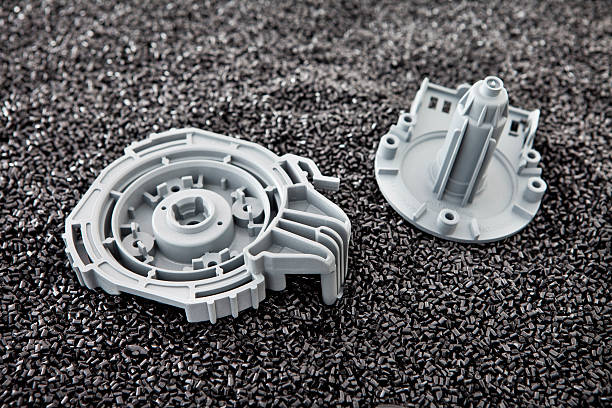
Introduction: Resolving the Over-Engineering vs. Under-Engineering Dilemma
Selecting the right thermoplastic resin for custom injection molding services is one of the most critical decisions in hardware product development. Product design engineers and procurement teams frequently encounter a common challenge: specifying an overly expensive material that inflates piece costs and tooling budgets, or choosing a low-cost commodity resin that fails prematurely under mechanical stress, thermal exposure, or chemical contact.
Among the vast array of available polymers, five core thermoplastics dominate the vast majority of commercial applications: ABS, PC, PA (Nylon), POM (Acetal), and PP (Polypropylene). Understanding the distinct mechanical, thermal, and chemical profiles of these five resins is vital for optimizing part performance while keeping unit costs within budget.
At WIN WIN, as a specialized injection molding manufacturer, we help global clients navigate material selection, structural DFM (Design for Manufacturability), and precision production. This guide details the core characteristics of these five main injection molding resins and introduces a practical three-step decision framework to streamline component procurement.
1. Core Properties & Typical Applications of the Big Five Thermoplastics
1. ABS (Acrylonitrile Butadiene Styrene): The Versatile All-Rounder
ABS is an amorphous thermoplastic widely recognized for its excellent dimensional stability, high impact strength, and ease of post-processing (painting, electroplating, and ultrasonic welding).
-
Key Characteristics: Good rigidity, balanced impact resistance, moderate thermal tolerance, low shrinkage, and excellent surface finish aesthetics.
-
Ideal Applications: Consumer electronics enclosures, automotive interior trim, medical device housings, and structural brackets.
2. PC (Polycarbonate): Optical Clarity & Superior Impact Strength
Polycarbonate is a high-performance amorphous engineering resin valued for its outstanding impact toughness and optical transparency.
-
Key Characteristics: Exceptional impact resistance (virtually unbreakable), high heat deflection temperature (HDT up to 120°C–130°C), and crystal clarity.
-
Ideal Applications: Light diffusers, transparent protective shields, optical lenses, high-temp automotive light housings, and heavy-duty structural covers.
3. PA / Nylon (Polyamide): High Strength & Wear Resistance
Polyamides (PA6, PA66) are semi-crystalline engineering plastics offering superior tensile strength, toughness, and self-lubricating sliding properties.
-
Key Characteristics: High mechanical strength, excellent fatigue resistance, high heat tolerance (especially when reinforced with glass fibers), and resistance to fuels and oils. Note: PA is hygroscopic and absorbs ambient moisture, which must be accounted for during dimensional planning.
-
Ideal Applications: Industrial gears, structural brackets, under-the-hood automotive components, and mechanical fasteners.
4. POM / Acetal (Polyoxymethylene): Precision & Low Friction
POM is a dense, highly crystalline engineering plastic known for its exceptional stiffness, dimensional stability, and low coefficient of friction.
-
Key Characteristics: High mechanical stiffness, superior creep resistance, self-lubrication, low moisture absorption, and tight tolerance retention.
-
Ideal Applications: Precision gears, bearings, conveyor belt links, sliding bushings, valves, and snap-fit assemblies requiring precise motion.
5. PP (Polypropylene): Chemical Resistance & Low-Cost Efficiency
Polypropylene is a widely used commodity resin praised for its low density, exceptional chemical inertness, and fatigue resistance.
-
Key Characteristics: Low raw material cost, lightweight, high resistance to acids and alkalis, excellent fatigue strength (enabling “living hinges”).
-
Ideal Applications: Consumer goods packaging, fluid containers, living hinge closures, automotive battery cases, and medical disposable items.
2. Engineering Comparison Matrix: ABS vs. PC vs. PA vs. POM vs. PP
To assist procurement managers and mechanical engineers in identifying candidate materials, the table below compares core engineering metrics and application fit.
| Resin Family | Polymer Structure | Tensile Strength / Rigidity | Impact Resistance | Heat Deflection Temp (HDT) | Chemical Resistance | Relative Material Cost | Primary Target Applications |
| ABS | Amorphous | Moderate to High | High | Moderate (~80°C–90°C) | Vulnerable to solvents | Moderate / Cost-Effective | Device housings, cosmetic covers, instrument panels |
| PC | Amorphous | High | Exceptional (Impact-Proof) | High (~120°C–130°C) | Moderate (Sensitive to chemicals) | High | Optical lenses, transparent guards, structural shields |
| PA (Nylon) | Semi-Crystalline | Very High (Higher with Glass Fiber) | High (Tough) | High (Up to 150°C+) | Excellent (Oils, fuels, solvents) | High | Load-bearing gears, engine components, brackets |
| POM (Acetal) | Semi-Crystalline | High / Rigid | Moderate to High | High (~100°C–120°C) | Excellent (Solvents & fuels) | Moderate–High | Precision gears, sliding bearings, snap-fits |
| PP | Semi-Crystalline | Low to Moderate | Moderate | Moderate (~80°C–100°C) | Superior (Acids, bases, fluids) | Low (Economical) | Living hinges, fluid tanks, packaging, containers |
3. The 3-Step Procurement Decision Framework
When selecting resins for custom injection molding services, technical buyers should use a structured evaluation process rather than relying on unit price alone:
Step 1: Environmental Assessment ➔ Step 2: Mechanical & Load Analysis ➔ Step 3: Cost & Process Optimization
(Temperature, UV, Chemicals)       (Impact, Friction, Fatigue)           (Resin Cost vs. Cycle Time)
Operating Environment Assessment
-
Temperature Extremes: If operating temperatures exceed 100°C, eliminate ABS and standard PP. Shift toward PC, PA, or POM.
-
Chemical Exposure: If exposed to oils, greases, or solvents, avoid amorphous resins like ABS and PC. Opt for semi-crystalline options such as PP, PA, or POM.
-
UV Exposure: Standard PC and ABS degrade under direct sunlight unless formulated with specialized UV stabilizers.
Mechanical Load & Motion Requirements
-
Dynamic Sliding & Precision Motion: Choose POM or PA for low wear, low friction, and continuous cycling.
-
High Impact & Drop Resistance: Select PC for severe impact protection or ABS for moderate drop requirements.
-
Flexural Fatigue (Living Hinges): Select PP to survive millions of flex cycles without fracturing.
Total Cost & Process Optimization
Avoid over-specifying engineering resins for non-critical cosmetic parts. Where possible, consider resin alloys (such as PC/ABS blends) to achieve a ideal balance of impact strength, heat tolerance, and cost efficiency.
4. Partner with WIN WIN: Custom Injection Molding Solutions
Selecting the optimal plastic resin requires balancing mechanical performance, mold design constraints, and production economics. At WIN WIN, we deliver end-to-end support as a trusted injection molding manufacturer:
-
Engineering Material Selection: Our team evaluates your 3D CAD models, load profiles, and target operating environments to recommend cost-effective resin grades.
-
Precision Tooling & Prototyping: We build high-durability injection molds with optimized cooling channels to reduce mold cycle times and piece part costs.
-
Comprehensive Quality Assurance: From raw material resin drying to automated CMM dimensional inspection, every batch meets strict tolerance specifications.
Conclusion: Make Data-Driven Injection Molding Decisions
Material selection directly impacts part durability, visual appearance, and manufacturing profitability. By evaluating environmental factors, mechanical loads, and processing needs across ABS, PC, PA, POM, and PP, product teams can select the best resin without overspending.
Partner with WIN WIN for your next custom molding project. Contact our engineering sales team today to request DFM feedback, resin consultation, and a quick-turn manufacturing quote.




Add comment