

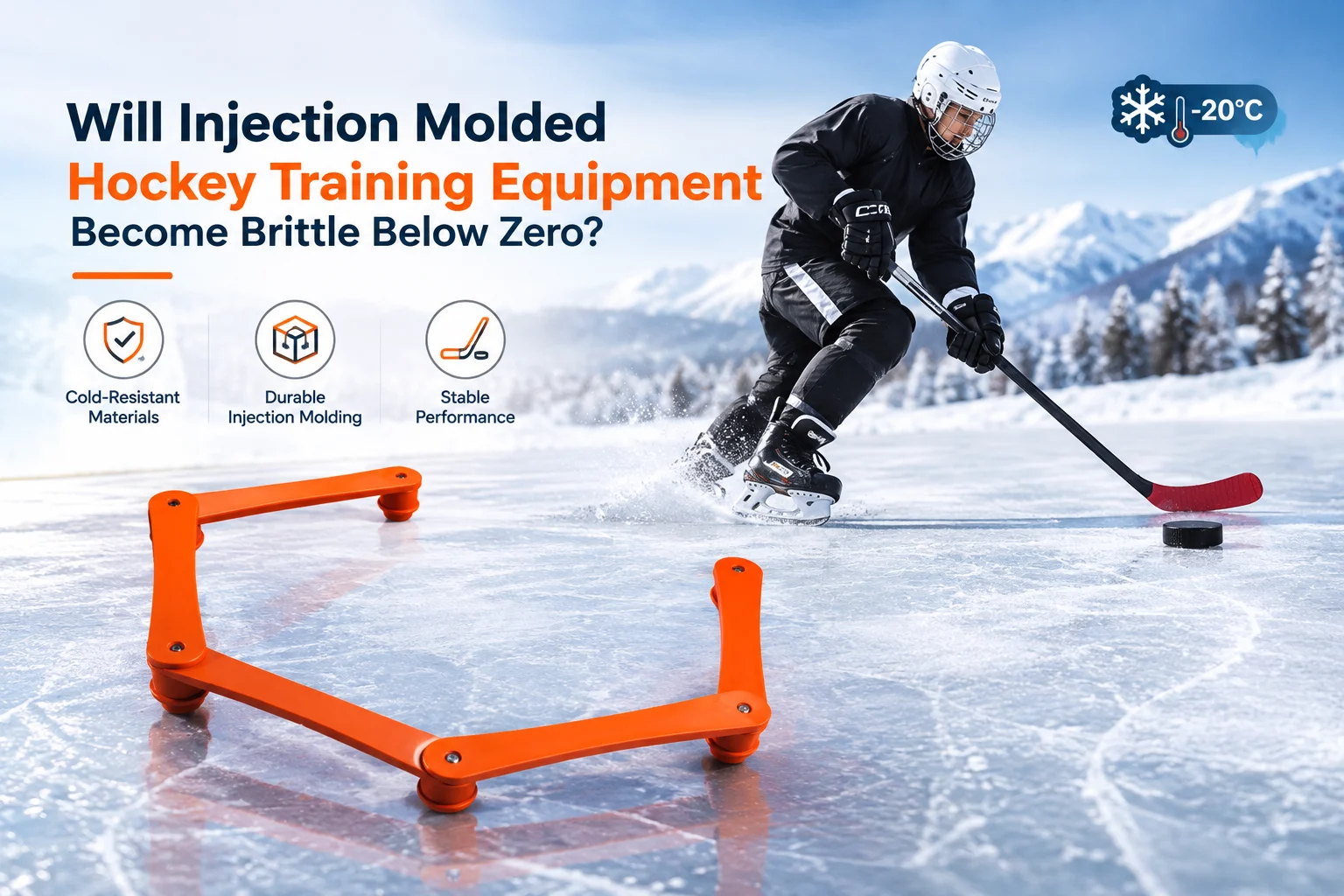
For injection molded hockey training equipment, low-temperature performance is not a minor material detail. Hockey rinks expose plastic components to cold air, chilled surfaces, repeated impacts, and sudden loads. If the plastic becomes too brittle at low temperatures, a training aid that performs well at room temperature may crack, deform, or fail after repeated use.
This is why low temperature injection molded hockey training equipment requires more than a standard plastic grade. Material selection, part geometry, wall thickness, impact points, and injection molding conditions all contribute to whether a component can maintain toughness and dimensional stability on the ice.
ABS is often considered for this type of application because properly selected ABS grades can provide a useful balance of toughness, stiffness, processability, and dimensional stability. However, not every ABS grade provides the same low-temperature performance. SABIC, for example, describes certain CYCOLAC ABS grades as offering good low-temperature ductility and high dimensional stability, while its product portfolio also includes very-high-impact ABS grades.
The real question for buyers is therefore not simply:
“Is ABS suitable for an ice rink?”
It is:
“Is the selected material and molded structure suitable for repeated impact at the actual operating temperature?”
Why Does Plastic Become More Brittle in Cold Environments?
Most thermoplastics change their mechanical behavior as temperature decreases.
As temperature falls, molecular movement becomes more restricted. Depending on the polymer structure and formulation, the material can lose some of its ability to absorb impact energy and may behave in a more brittle manner.
This creates a significant difference between two situations:
- A plastic part surviving a static load at room temperature.
- A plastic part surviving repeated impact in a cold rink.
The second condition is much more demanding.
A hockey training device may experience:
- Stick impacts
- Puck impacts
- Repeated player contact
- Fast assembly and disassembly
- Dropping during transportation
- Contact with cold ice
- Bending or twisting during use
The failure mechanism may therefore involve impact + low temperature + repeated loading, rather than temperature alone.
Does ABS Become Brittle on an Ice Rink?
The answer is:
Some ABS formulations can lose impact toughness at low temperatures, but ABS as a material family should not be treated as having one universal low-temperature performance.
ABS is a terpolymer system containing acrylonitrile, butadiene, and styrene components. Its formulation can be adjusted to achieve different balances of stiffness, toughness, flow, heat resistance, and other properties.
This is why material grade selection matters.
For example, SABIC identifies some ABS grades as high-impact or very-high-impact, while other grades prioritize characteristics such as flow, heat resistance, or general-purpose processing.
INEOS similarly lists ABS grades with different impact-performance profiles and specifically describes one high-impact grade as offering superior toughness for low-temperature applications.
Therefore, specifying simply:
Material: ABS
is not enough for an ice-hockey training product.
A better specification should identify:
ABS grade + impact requirement + operating temperature + part geometry + validation method
Why High-Impact ABS Can Be a Better Choice
For training equipment used on ice, impact resistance is often more important than maximum stiffness.
A high-impact ABS formulation is designed to absorb more mechanical energy before cracking than a general-purpose formulation with a different property balance.
This is particularly relevant when the component is repeatedly struck.
SABIC’s CYCOLAC portfolio includes very-high-impact ABS grades as well as general-purpose grades, illustrating why the ABS family cannot be evaluated as a single performance category.
For a hockey training device, the preferred material profile may therefore look like:
| Property | Why It Matters |
|---|---|
| Low-temperature toughness | Reduces brittle fracture risk |
| Impact strength | Handles puck and stick impacts |
| Dimensional stability | Maintains geometry during repeated use |
| Fatigue resistance | Helps withstand repeated loading |
| Flowability | Enables consistent injection molding |
| Surface durability | Supports repeated contact |
| UV/weather resistance | Important for outdoor or semi-outdoor use |
The exact balance depends on whether the training equipment is designed exclusively for indoor ice rinks or also for outdoor training.
Low Temperature Is Only Half of the Problem
One of the biggest mistakes in product development is treating temperature as the only variable.
Imagine two identical ABS training components.
Part A
- 20°C environment
- Occasional impact
- Low loading frequency
- Smooth geometry
Part B
- Below-zero environment
- Repeated stick and puck impacts
- Frequent bending
- Stress concentration around holes and corners
Even if both parts use the same ABS grade, their real-world failure risk can be very different.
This is because plastic durability depends on the combination of:
Temperature + load + geometry + material + processing + exposure time
For hockey training equipment, repeated impact is particularly important.
A component that survives one cold-temperature impact test may still develop cracks after thousands of repeated impacts.
How Part Geometry Affects Cold-Temperature Cracking
Material selection cannot compensate for poor geometry.
A strong polymer can still fail if the part contains severe stress concentrations.
Avoid Sharp Internal Corners
Sharp corners concentrate stress.
When a cold plastic part receives an impact, the local stress can become significantly higher around:
- Sharp internal corners
- Thin-to-thick transitions
- Small holes
- Narrow ribs
- Snap-fit features
- Screw bosses
- Sudden wall-thickness changes
For injection molded hockey training equipment, generous radii at high-stress locations can help distribute loads more effectively.
Better Design
Instead of:
Thin wall → sharp 90° corner → thick boss
consider:
Controlled wall transition → fillet radius → reinforced boss
This can reduce localized stress concentration.
Wall Thickness Also Matters
Wall thickness is another important design variable.
A very thin section may not provide enough material to absorb repeated impact.
However, simply making the entire component thicker is not always the best solution.
Excessive thickness can introduce:
- Sink marks
- Longer cooling cycles
- Uneven shrinkage
- Internal stress
- Increased material cost
- Longer molding time
A better strategy is to place material where the load requires it.
For example:
Thin main wall + strategically positioned ribs + reinforced impact zones
can provide a better balance than simply increasing the overall wall thickness.
Ribs Can Improve Strength Without Excessive Material
Ribs are commonly used to increase stiffness in injection molded components.
For hockey training equipment, they can help support:
- Long flat sections
- Base structures
- Connecting areas
- Mounting points
- Load-bearing frames
But ribs also need careful design.
A rib that is too thick can create molding defects and local shrinkage. A rib that terminates abruptly can also introduce stress concentration.
For cold-weather applications, the goal should be:
Controlled reinforcement rather than maximum reinforcement.
The design engineer should consider the direction and location of expected impact forces.
The Injection Molding Process Can Affect Low-Temperature Performance
Material grade alone does not determine the final performance of a molded part.
Processing conditions can influence:
- Molecular orientation
- Residual stress
- Weld-line strength
- Internal defects
- Dimensional stability
- Surface quality
This is especially important for large or irregular hockey training components.
Weld Lines Need Special Attention
When molten plastic flows around an insert, rib, hole, or other feature, separate flow fronts may meet and create a weld line.
A weld line can become a potential weakness under impact.
At room temperature, the part may appear completely acceptable.
At low temperature, however, the reduced toughness of the polymer system can make a weak weld-line region more vulnerable to cracking.
Therefore, gate location and flow direction should be considered during mold design.
Why Gate Location Matters for Hockey Training Parts
A poorly positioned gate can create unfavorable flow patterns.
For an impact-sensitive component, the mold designer should consider:
- Where the primary impact occurs
- How the melt flows through the part
- Where weld lines will appear
- Where air may become trapped
- Whether the fiber orientation is relevant to the selected material
- Whether the part will experience bending around the gate region
The goal is not simply to fill the mold.
The goal is to produce a molded structure with consistent mechanical performance in the areas that matter most.
Dimensional Stability Matters on the Ice
Impact resistance gets most of the attention, but dimensional stability is equally important.
Training equipment often needs to maintain a specific geometry.
If a component gradually changes shape, it can affect:
- Training accuracy
- Alignment
- Assembly
- Interchangeability
- Moving clearances
- Connection strength
ABS is attractive for many molded applications partly because certain grades offer a combination of low-temperature ductility and dimensional stability.
However, actual dimensional stability depends on the selected grade, part design, processing conditions, and temperature exposure.
Why Repeated Impact Is More Important Than One-Time Impact
A training device may be used for multiple seasons.
That means the relevant engineering question is not:
“Can the part survive one impact?”
It is:
“Can the part survive thousands of impact cycles without crack initiation and propagation?”
This is a fatigue and durability question.
A typical usage cycle could involve:
Cold exposure → impact → recovery → impact → bending → transport → cold exposure → repeated impact
Over time, small defects may become crack initiation points.
Therefore, buyers should evaluate durability based on the intended service cycle rather than a single drop or impact event.
How to Select ABS for Ice Hockey Training Equipment
A practical material-selection process can use five steps.
Step 1: Define the Minimum Operating Temperature
Do not simply specify “cold environment.”
Define the expected range.
For example:
- +5°C to 0°C
- 0°C to -10°C
- -10°C to -20°C
The appropriate material selection can change significantly depending on the actual requirement.
Step 2: Define the Impact Scenario
Ask:
- What hits the component?
- How fast is the impact?
- Where does the impact occur?
- How many cycles are expected?
- Is the impact concentrated or distributed?
A puck impact and a player’s body contact do not produce the same loading pattern.
Step 3: Compare Material Data at Relevant Temperatures
Do not rely only on room-temperature Izod or Charpy values.
Room-temperature impact data can help compare materials, but low-temperature performance should be evaluated using supplier data or testing relevant to the actual operating range.
Material suppliers publish different impact grades precisely because performance requirements vary. SABIC’s portfolio, for example, includes general-purpose, high-impact, and very-high-impact ABS grades.
Step 4: Review Part Geometry
Check:
- Wall thickness
- Corners
- Ribs
- Bosses
- Holes
- Snap fits
- Weld lines
- Impact zones
Step 5: Validate the Complete Molded Part
The final product should be tested as a molded assembly rather than evaluating resin data alone.
This is particularly important because molding conditions and geometry can influence actual performance.
High-Impact ABS vs. General-Purpose ABS
The comparison should not be reduced to “strong versus weak.”
Different grades are optimized for different balances of properties.
| Factor | General-Purpose ABS | High-Impact ABS |
|---|---|---|
| Cost | Often lower | May be higher |
| Flow | Often easier | Grade dependent |
| Impact resistance | Moderate to good | Higher priority |
| Cold impact | Grade dependent | Usually a stronger selection focus |
| Rigidity | Balanced | May trade some stiffness for toughness |
| Ice-rink suitability | Application dependent | Often more suitable for impact-focused designs |
| Repeated impact | Application dependent | Better candidate for evaluation |
| Customization | Broad | Broad |
The correct choice depends on the specific application.
For an impact-heavy hockey training product, high-impact or low-temperature-impact grades should be evaluated first, rather than automatically selecting the lowest-cost general-purpose ABS.
What About PC/ABS?
For some applications, PC/ABS may also be considered.
PC/ABS blends can provide a different balance of toughness, heat resistance, and processing characteristics. For example, SABIC lists CYCOLOY PC/ABS grades with characteristics including high impact and low-temperature impact.
However, PC/ABS should not automatically replace ABS.
The material decision should consider:
- Required impact performance
- Temperature range
- Cost target
- Moldability
- Surface requirements
- Chemical exposure
- Color requirements
- Part size
- Expected service life
For a cost-sensitive training accessory, a properly selected high-impact ABS may provide a better overall solution than moving to a more expensive polymer blend.
Can Better Material Make a Training Device Last Several Seasons?
Potentially, yes—but material grade alone cannot guarantee a specific service life.
The lifespan of injection molded hockey training equipment depends on:
Material + geometry + molding quality + impact severity + temperature + usage frequency + storage + maintenance
For example, a high-impact ABS component with poor weld-line design can still fail prematurely.
Conversely, a well-designed component using an appropriate general-purpose grade may perform adequately under moderate loading.
For buyers, the better approach is to define the required service conditions and validate the complete part against them.
A Practical Buyer Checklist for Low-Temperature Plastic Training Equipment
Before approving an injection molded hockey training product, buyers should ask the supplier:
Material
- What exact resin grade is being used?
- Is it high-impact ABS?
- Is low-temperature impact data available?
- What is the recommended operating temperature?
- Is recycled material included?
Design
- Where are the primary impact zones?
- Are sharp corners minimized?
- Are high-load areas reinforced?
- Where are the weld lines?
- Has wall thickness been optimized?
Molding
- What is the gate location?
- How are weld lines controlled?
- Are molding parameters documented?
- Is dimensional inspection performed?
Validation
- Has the finished part been tested below zero?
- Was impact testing performed after cold conditioning?
- Has repeated-impact testing been performed?
- Are dimensional measurements taken before and after testing?
These questions help buyers move from a material-name-based purchasing decision to a performance-based specification.
What Should B2B Buyers Specify in an RFQ?
A strong RFQ for custom injection-molded hockey equipment could include:
| Requirement | Example Specification |
|---|---|
| Application | Ice hockey training equipment |
| Manufacturing | Custom injection molding |
| Base material | ABS |
| Material class | High-impact / low-temperature grade |
| Operating environment | Below-zero rink environment |
| Impact requirement | Repeated puck and stick impact |
| Critical dimensions | Defined by drawing |
| Surface | Mold texture or specified finish |
| Color | Custom color |
| Validation | Low-temperature impact testing |
| Quantity | Annual production forecast |
| Customization | OEM/ODM design support |
This gives the molding supplier enough information to recommend a suitable material and mold structure.




Add comment